
Carson Wood Flooring builds, converts and refinishes hardwood stairs in Carson, CA, serving surrounding cities including West Carson, Compton, Wilmington, West Rancho Dominguez, East Rancho Dominguez. In more than 20 years on wood floors, we have found that stairs are where careful measuring and fitting show most, because every step is seen up close and walked on hundreds of times a week.
We price stair work per tread and riser, not folded into a square-foot number. Stairs take far more labor than a flat floor, and a per-tread price shows you exactly what the staircase costs while keeping the flat floor priced honestly.
New Hardwood Treads, Risers and Nosings
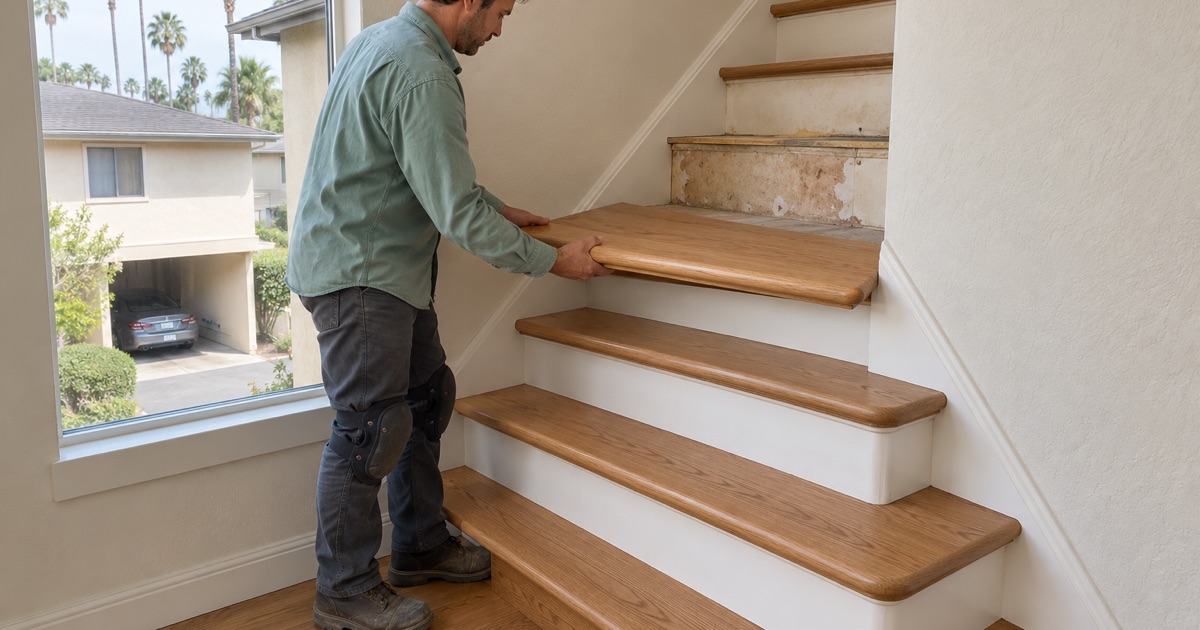
Measuring and Fitting Each Step
Stairs are rarely as uniform as they look. Each tread can vary in depth and width, and the walls or stringers beside them are often slightly out of square. We measure and scribe every tread individually so it fits tight to the wall and the riser, rather than cutting a stack of identical pieces and filling the gaps with caulk.
Tread and Riser Materials
Treads take the most wear, so they are usually solid hardwood in the same species as the adjoining floor: red oak, white oak, hickory or maple. Risers can be matching wood or painted, which many owners prefer for contrast and easy cleaning. We glue and fasten each piece so it stays silent underfoot.
Stair Nosing at Landings and Floors
The stair nosing is the rounded front edge of each tread and the piece that ties the stairs into the floor at the top landing. Where the floor meets the stairs, we fit a nosing that matches the floor’s thickness and finish, so the transition is flush and safe. A loose or mismatched nosing is an easy trip point to overlook, so we check it on every staircase.
Open Sides, Returns and Landings
A staircase with an open side needs return nosings, where the tread’s front edge wraps around the exposed end, and those have to be mitered cleanly by hand. Landings are treated as small floors and are usually laid in the same boards as the rooms around them, with a nosing at the edge. We price returns and landings separately on the estimate, so a complex staircase is not hidden inside a simple number.
Winder stairs, where the treads turn a corner, take the most fitting time of all, since every tread is a different shape. We template each one before cutting.
Converting Carpeted Stairs to Hardwood
What Is Under Stair Carpet
When stair carpet comes off, there are usually two possibilities: solid wood treads that were carpeted later, or construction-grade treads that were only ever meant to be covered. We check which you have before quoting. Solid treads may be refinished once staples and tack strip are removed, while construction-grade treads need new hardwood.
Cap Treads or Full Replacement
Where existing treads are structurally sound, new hardwood can sometimes be installed over them as cap treads, which avoids demolishing the staircase. Where they are damaged or the rise between steps would become uneven, full replacement is the better choice. Every step in a staircase needs a consistent rise for safety, and we plan the new material around that.
Adding thickness to every tread also changes the height of the top and bottom steps where they meet the floor. We measure the finished rise at both ends before ordering material, so the first and last steps are not noticeably taller or shorter than the rest.
Refinishing Existing Hardwood Stairs
Hand Work on Every Tread
Large floor sanders cannot work on stairs, so stair refinishing is done with edgers, detail sanders and hand scraping. Each tread, riser and nosing is sanded back, repaired where needed, and finished separately. It is slower work than a floor, which is another reason stairs are priced per tread and riser.
Railings, Balusters and Newel Posts
Wood railings and newel posts can be sanded and refinished to match the treads, or painted for contrast. Balusters are often painted, especially when they are original to the house. In homes built before 1978, painted railings and balusters are handled with lead-safe work practices before any sanding takes place.
Finishes and Safety on Stairs
Choosing a Finish and Sheen
Stairs take concentrated traffic on a small area, so they benefit from a durable finish applied in enough coats. A satin or matte sheen offers better grip than gloss and hides wear. Every finish we use meets the South Coast air basin’s 275 g/L limit for wood coatings.
Where grip matters most, such as homes with young children, older residents or dogs, a stair runner fixed down the center of the treads adds traction while leaving the wood visible at each side. We can leave the treads ready for a runner, so the installer has a clean, finished surface to fasten to.
Squeaky Stairs
A stair that squeaks usually has a tread moving against its riser or stringer. Before refinishing or capping, we glue and fasten any loose treads from above or below, so the new finish is not laid over a noise that will keep getting worse.
Keeping the House Usable During the Work
Stairs are often the only route between floors, so we plan the order of work and the cure schedule to keep the household moving. Where possible, we finish alternate treads first so the stairs can be used carefully while the rest cure. You receive a written schedule showing when the stairs can take normal traffic again.
- 20+ Years on Wood Floors
- Moisture Readings in Writing
- Air-Basin-Compliant Finishes